
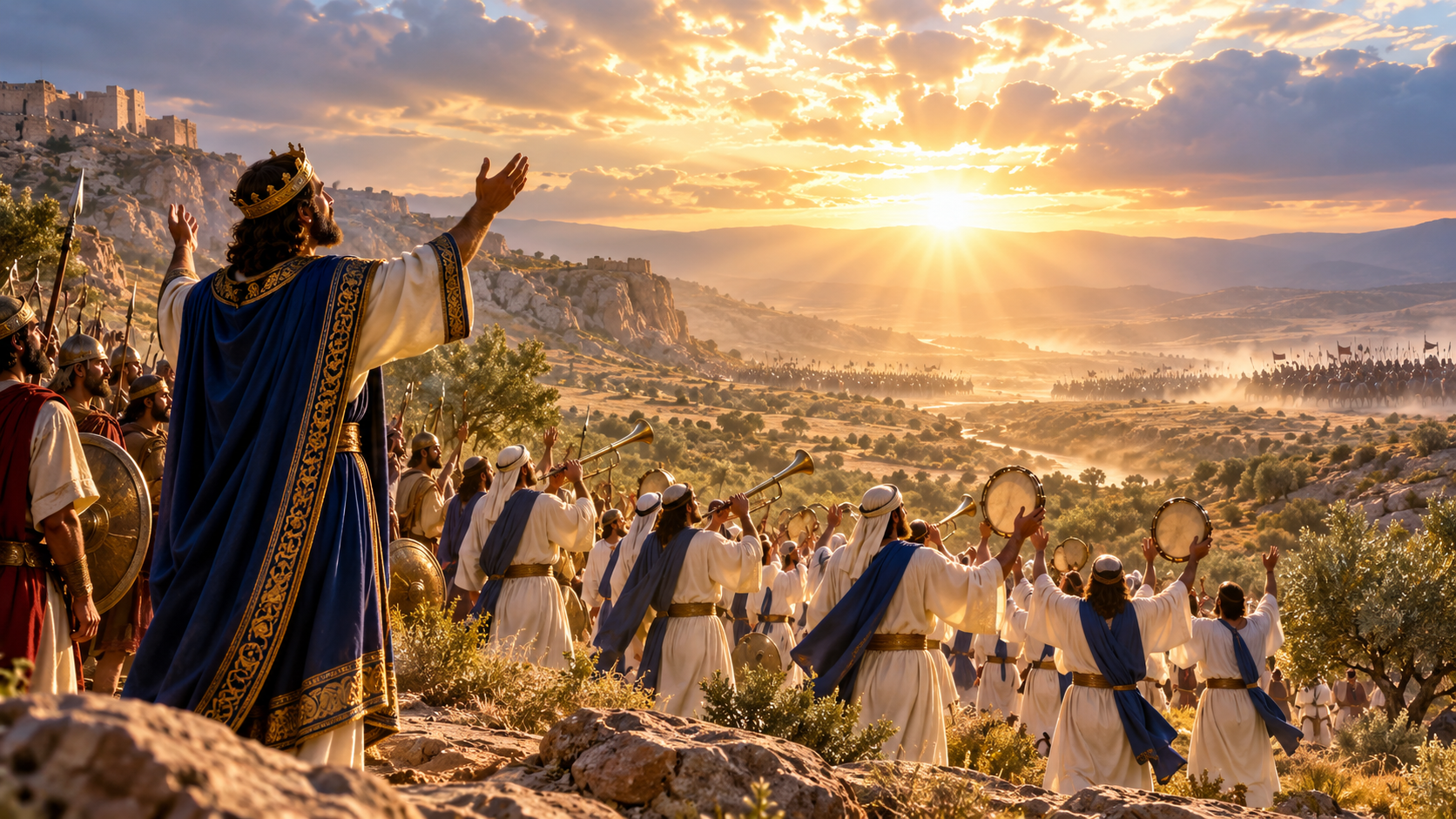
When Jehoshaphat faced a great threat, fear did not have the final word. He set himself to seek the LORD, gathered the people to pray, acknowledged God's sovereignty, stood still in faith, and led Judah to worship before the battle was won. The chapter also warns us that one great moment of faith is not enough—we must continue walking faithfully with God.
Scripture
2 Chronicles 20:15 KJV
Loading KJV Scripture…
There are moments when trouble arrives so suddenly that we do not know what to do.
That is the situation in 2 Chronicles 20. A great multitude was coming against Judah, and Jehoshaphat was afraid. But verse 3 shows us something important: fear was not his final response. “Jehoshaphat feared, and set himself to seek the LORD.” Fear came, but he deliberately turned toward God.
Verse 4 continues:
“And Judah gathered themselves together, to ask help of the LORD: even out of all the cities of Judah they came to seek the LORD.” This is the right response to calamity. Scripture gives us many examples of rulers who, when threatened, looked first to military strength, political alliances, foreign powers, idols, or their own wisdom. Jehoshaphat himself had previously made a dangerous alliance with Ahab and had been rebuked for it. Yet here, when crisis came, he did something different. He sought the LORD. He called the people to seek the LORD. He did not pretend the danger was small. He simply recognized that God was greater. That becomes very clear in verses 6 and 7. Jehoshaphat begins his prayer by acknowledging who God is:
“O LORD God of our fathers, art not thou God in heaven? and rulest not thou over all the kingdoms of the heathen? and in thine hand is there not power and might, so that none is able to withstand thee?”
Before he speaks about the enemy, he speaks about God. Before he describes the crisis, he remembers God's sovereignty. That is a lesson I need again and again.
When trouble comes, my prayers can easily become a long description of everything that is wrong. There is nothing wrong with bringing our burdens honestly before God. But Jehoshaphat reminds us that prayer also means lifting our eyes above the problem and remembering who God is.
He is God in heaven. He rules over kingdoms. Power and might are in His hand. No situation is outside His authority. Then comes one of the most honest statements in the chapter. In verse 12 Jehoshaphat admits, “neither know we what to do: but our eyes are upon thee.” Sometimes faith is not knowing exactly what to do next. Sometimes faith is simply knowing where to look.
The answer from God comes in verse 15:
“Be not afraid nor dismayed by reason of this great multitude; for the battle is not yours, but God's.”
And in verse 17:
“Ye shall not need to fight in this battle: set yourselves, stand ye still, and see the salvation of the LORD with you.”
This does not mean God's people never have responsibilities or never take action. In this very passage they were told to go out toward the enemy. But the victory would not come from their own strength. Their responsibility was obedience. The battle belonged to God. There are battles in our lives that exhaust us because we keep trying to carry what only God can carry. We plan. We worry. We rehearse every possible outcome. We try to control people and circumstances. But there are times when God brings us to the place where we must say, “Lord, I do not know what to do, but my eyes are upon You.”
Then something beautiful happens. Before Judah saw the victory, they worshipped. Jehoshaphat appointed singers to praise the LORD. They went before the army saying: “Praise the LORD; for his mercy endureth for ever.”
Verse 22 says, “And when they began to sing and to praise,” the LORD began to act against their enemies. Their praise did not begin after the battle was over. They praised while they were still walking toward it. That is faith. It is easy to thank God when the answer is already visible. Faith worships because God is worthy even before we know how the situation will end.
Yet the chapter gives us another important warning.
A powerful experience with God does not automatically make us faithful for the rest of our lives. Later in the same chapter, verses 35–37 tell us that Jehoshaphat joined himself with Ahaziah king of Israel, “who did very wickedly.” A prophet rebuked him, saying, “Because thou hast joined thyself with Ahaziah, the LORD hath broken thy works.” Jehoshaphat had seen an extraordinary deliverance.
He had prayed. He had worshipped. He had watched God fight for Judah. Yet later he still made an unwise alliance. That should humble us. Yesterday's victory does not remove today's need to seek God. A strong prayer life during a crisis does not mean we can become careless afterward. We need God when the enemy is approaching, and we need God when life becomes calm again. We need Him before the battle, during the battle, after the battle, and every ordinary day that follows.
So the message of 2 Chronicles 20 is more than, “The battle is not yours.”
It is also:
Seek the LORD when you are afraid. Acknowledge His sovereignty. Keep your eyes upon Him when you do not know what to do. Obey what He tells you. Worship before you see the outcome. Give thanks for His mercy and when the victory comes, keep walking faithfully. The God who fought for Judah is still sovereign. Whatever is in front of us today, our confidence is not in our own strength. Our eyes are upon Him.
Reflection
When trouble comes, what is my first response—panic, human solutions, or seeking the LORD? Do my prayers begin by telling God how big my problem is, or by remembering how great and sovereign He is? Is there a battle I am trying to carry in my own strength that I need to place back into God's hands? After God gives me victory, will I continue to seek Him, or slowly return to compromises and self-reliance?
Prayer
LORD God, You are God in heaven, and You rule over every kingdom, every circumstance, and every situation I face. Power and might are in Your hand, and nothing is too difficult for You. When fear comes, teach me to respond as Jehoshaphat did—to seek You first. Keep me from running immediately to human strength, anxious plans, or wrong alliances. Help me remember who You are before I focus on what is against me. When I do not know what to do, help me keep my eyes upon You. Teach me to stand still when You tell me to stand, to move when You tell me to move, and to trust that the battle belongs to You. Put praise in my mouth before I see the outcome. Give me a thankful heart that worships You not only after the victory, but while I am still waiting. And Lord, keep me faithful after the crisis has passed. Do not let yesterday's victory become today's confidence in myself. Guard me from compromise, wrong partnerships, and decisions that pull my heart away from You. Let my life continually acknowledge Your sovereignty and depend on Your presence. In Jesus' name, Amen.
Want a Printable Copy?
Receive this Peaceful Streams resource as a free PDF for personal study, family devotions, Sunday School, or ministry use.
Verse of the Day & Daily Devotion
Free email updates from Peaceful Streams. Unsubscribe anytime.
Approved Comments
Only approved comments appear here.Leave a Comment
Share a thought or encouragement. Your email is never shown publicly. Your comment will appear after approval.